Case study · 06 · Robotics
The robotic arm that started my habit of building things.
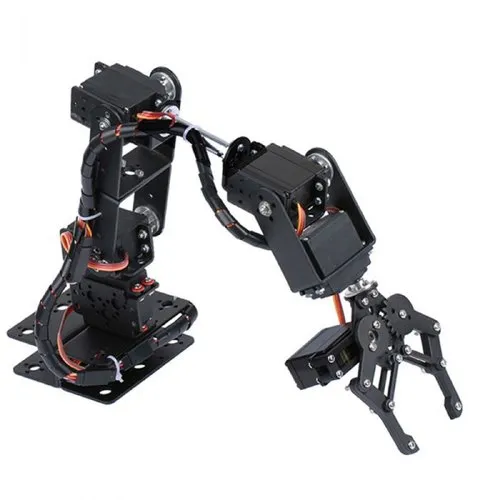
A servo‑driven arm built with an Arduino, later extended so it mirrors the operator's hand through a gyroscope. It earned SP Robotics' Maker of the Month in September 2018.
Overview
This was the first project that made engineering feel tangible to me. I assembled the arm, wired the servo system and programmed base, shoulder, elbow and gripper movement in the Arduino IDE. There was nowhere for a mistake to hide. Weak power delivery, a bad angle or loose wiring showed up immediately as motion that was slow, unstable or completely wrong.
A later version added a gyroscope that read the operator's hand orientation, scaling pitch and roll into servo targets so the arm could mirror gestures. It earned SP Robotics' Maker of the Month, but what stayed with me was the curiosity: I want to know what happens after the software leaves the screen.
How it works
- Three axes plus grip. Base, shoulder, elbow and gripper servos each map to an input, giving three dimensions of motion and a controlled grasp.
- Clean power. A dedicated servo controller supplies power and PWM, so the Arduino only has to send target angles.
- Smoothing. Target angles are interpolated across frames, which removes the jerk and reduces mechanical stress.
- Gesture mode. A gyroscope reports hand orientation; pitch and roll scale into servo angles for direct mirroring.
Impact
Gallery